


A Practical Guide for Procurement and Engineering Teams
Moisture is one of the most underestimated risks in electronics manufacturing. It doesn't always show immediate damage, but it can quietly
compromise product reliability. For anyone working with ICs, PCBs, BGAs, or other moisture-sensitive devices (MSDs), uncontrolled humidity
is a real concern.
The problem is well understood in the industry. When moisture-laden components go through reflow soldering, the trapped water vapor
expands rapidly. The result can be internal cracks, delamination, or what engineers often call the "popcorn effect." These defects are not
always visible after assembly. But they can show up later as field failures, which are far more costly to address.
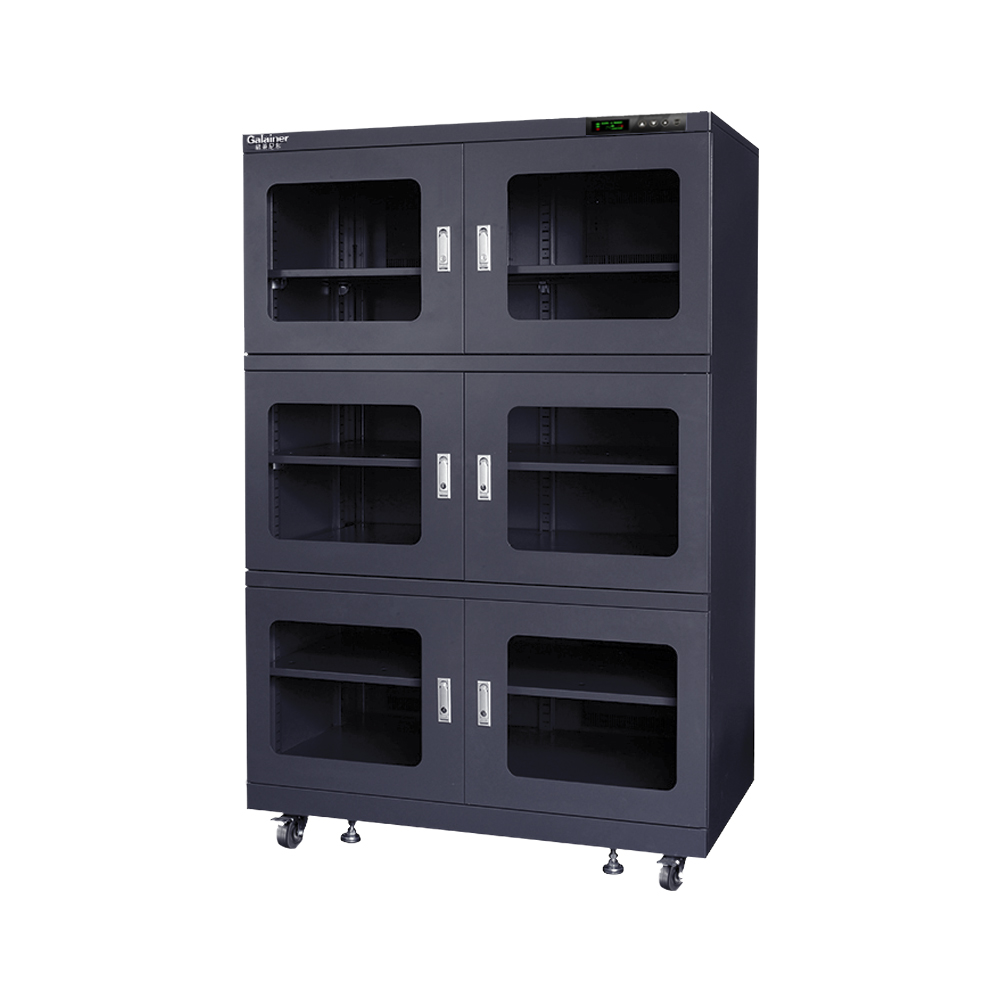
Choosing a suitable dry storage solution is not complicated, but it does require a few clear decisions. Here is a practical breakdown.
1. Start with Two Basic Questions
Before looking at any product specifications, it helps to step back and clarify what you actually need.
First, what are you storing? Standard PCBs are less sensitive than unpackaged ICs or semiconductor wafers. Optical lenses and precision
instruments have different requirements again. Knowing what goes into the cabinet is the starting point.
Second, how much do you need to store? This determines the capacity. Many users tend to underestimate or overestimate the volume
required. A cabinet that is too large wastes floor space and energy. One that is too small leads to cramming, which reduces airflow and
makes retrieval more difficult. The right size is the one that matches your actual workload, not the one that looks impressive on paper.
2. Humidity Levels – The Core Parameter
The most important technical specification is the humidity control range. Different components have different needs, and these are not
arbitrary. They are defined by the IPC/JEDEC J-STD-033 standard, which is widely used in the industry.
Here is a rough guide:
Below 5% RH – This is the ultra-low range. It is suitable for MSDs such as BGAs, QFPs, semiconductor wafers, and other components that
are sensitive to moisture during reflow. At this level, the floor life of these devices can be effectively paused, which gives production planners
more flexibility.
10% to 20% RH – This range works well for standard PCBs, printed circuit boards, and general electronic components that do not have
extreme sensitivity.
30% to 60% RH – This is for items that need some protection but are not highly moisture-critical. Optical lenses, precision instruments,
and certain metal parts fall into this category.
It is also worth noting that some applications benefit from nitrogen-based storage. Nitrogen cabinets use inert gas to keep humidity
extremely low and reduce oxidation. They are not always necessary, but for wafer handling or long-term storage of sensitive optics,
they offer an extra layer of protection that desiccant cabinets alone may not provide.
3. Industry Standards and What They Mean
Compliance with IPC/JEDEC J-STD-033 is often the baseline for electronics manufacturers. It defines how moisture-sensitive devices
should be handled, baked, stored, and tracked throughout their floor life.
When selecting a cabinet, it is not enough to look at the claimed humidity range. The real question is whether the cabinet can maintain
that level consistently over time, without excessive fluctuations. Stability matters more than peak performance. Some cabinets advertise
very low humidity levels but struggle to hold them during frequent door openings. This is something to check during evaluation.
4. Additional Considerations – Certifications, Support, and Monitoring
There are a few other factors that can make a difference in daily operation.
Certifications – Products with CE, RoHS, or ISO9001 certification tend to come from manufacturers that have some level of quality control.
These are not guarantees, but they do reduce the risk.
After-sales support – It is useful to know the warranty period, the typical response time for technical queries, and whether spare parts are
readily available. These details often become important later, not at the time of purchase.
Monitoring and control – Digital displays and basic logging are now standard on most models. More advanced systems offer data recording,
alarm functions, and even integration with factory management software. The right level depends on your internal traceability requirements.
Also, check the product page carefully before reaching out. Some brands list detailed specifications and dimensional drawings online
. Looking through these first can save time and help you narrow down the options before contacting a supplier.
Final Thoughts
Choosing a dry cabinet is not about finding the most advanced model. It is about finding the one that fits your components, your workflow,
and your quality expectations. A well-chosen cabinet reduces the risk of moisture-related defects, helps with compliance, and gives the
engineering team one less variable to worry about.
Spending a few extra minutes on the selection process usually pays off. If you are unsure about a specific model or need clarification on
technical specifications, asking the supplier directly is usually the fastest way forward.